

 English
UEQ1
UEQ1 is a K-band FM continuous-wave 2D phased-array radar that employs advanced phased-array technology and intelligent signal processing algorithms. It combines low SWaP characteristics with all-weather, integrated air-ground target 4D information detection capabilities, as well as millisecond-level refresh rates, instantaneous response, precise perception of full target attributes, and stable tracking performance.
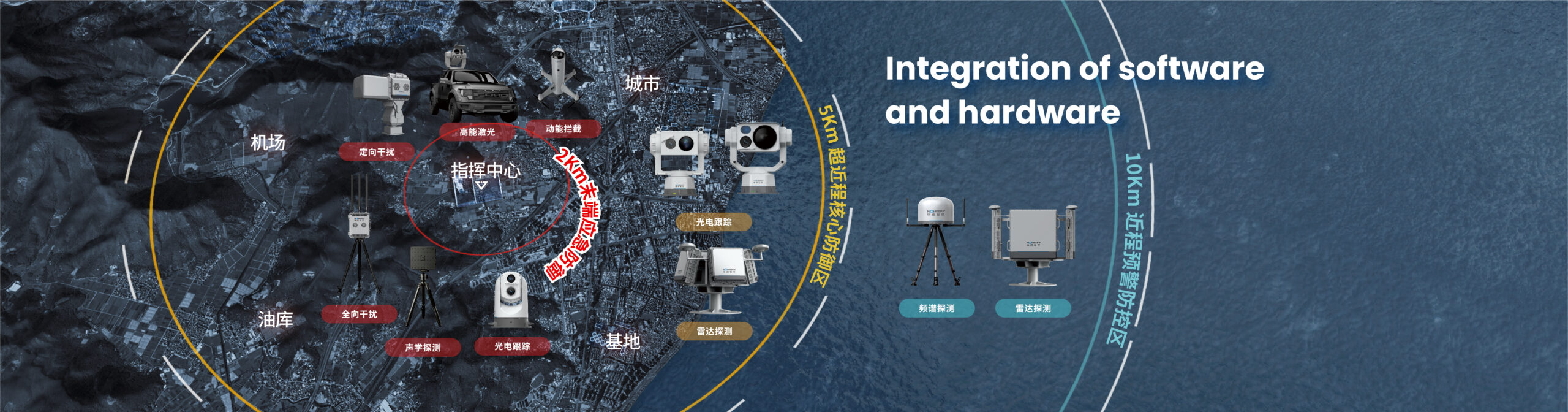
This equipment enables ultra-visual-range precise positioning and continuous tracking of diverse aerial unmanned aerial vehicles (including conventional, stealth, fiber-optic, and autonomous flight types), as well as ground-based personnel and vehicles. It provides users with clear, real-time, and reliable information support for decision-making, supports guidance optics and countermeasures systems, and offers flexible adaptability across fixed stations, vehicles, and UAV platforms.
core advantage:
The UEQ1 radar, leveraging an integrated "perception → decision → response" architecture, has achieved three major breakthroughs in the field of low-altitude security:
1)From "passive defense" to "proactive early warning": high refresh rate, wide-area coverage, early prediction of drone intrusion paths, and assistance in generating optimal interception strategies;
2)From "single-point detection" to "systemic synergy": it provides precise guidance capabilities and, when integrated with electro-optical and electronic warfare systems, forms a precise defense chain;
3)From "General-Purpose Equipment" to "Scenario-Specific Customization": providing differentiated algorithm packages tailored to specific scenarios—such as urban multi-path suppression and desert clutter filtering—for urban, border, and energy applications.
product features:
Beam Steering and Multi-Beam Rapid Scanning
Equipped with advanced beam-steering technology, this system leverages a core architecture comprising a phased array and digital beamforming to enable electrically controlled switching of beam direction, shape, and coverage—spanning from microseconds to milliseconds—without requiring mechanical rotation. It can rapidly switch beam directions while simultaneously generating multiple independent beams, thereby facilitating parallel detection, tracking, and identification of dozens or even hundreds of targets. The radar beam scanning process is characterized by high speed and the absence of mechanical inertia, allowing for high-density sampling in key areas, early target detection, and enhanced defense window periods.
Group target and high-mobility target tracking:
The radar beam supports flexible and agile steering, while time resources can be flexibly allocated. By leveraging an enhanced JPDA and deep learning-based trajectory prediction, this system addresses the issue of track confusion caused by the intersecting motions of dense targets. For highly maneuverable targets, it activates a "gaze mode" to increase the data update rate, ensure trajectory continuity, and provide fire-control-grade target indication for directed-energy weapons.
Strong interference rejection and minimal blind zones
By employing a frequency-modulated continuous-wave (FMCW) scheme, the radar can perform more refined analysis of the frequency characteristics of clutter. Combined with the beamforming capability of a phased array, it enables zeroing suppression in clutter direction, thereby enhancing the ability to distinguish targets from clutter. Additionally, its near-range blind zone is minimal (≤20 m), making it particularly suitable for target detection in complex environments involving low-altitude flight or close-range takeoff.
Target Recognition and Classification
By integrating target RCS, micro-Doppler features, and motion patterns, an AI classification model is constructed to accurately distinguish aerial targets—such as drones, birds, and floating objects—thereby providing a decision-making basis for subsequent countermeasures.
High precision and high resolution:
Utilizing synthetic bandwidth technology, the radar can output point cloud data of detected targets, enabling target imaging and meeting the requirements for precise target acquisition by electro-optical systems.
Interference Immunity and Frequency Conversion:
Utilizes advanced synchronous-asynchronous signal filtering technology to eliminate co-channel interference;
Strong adaptability to complex environments:
Intelligent algorithms, active learning, and false alarm management effectively filter out false alarms—such as non-interest target motion—while enabling one-click selection of radar algorithms tailored to specific scenario characteristics, thereby allowing the radar system to be optimally matched to its intended applications.
Flexible Networking and Integration:
Supports 360° flexible networking and wireless ad-hoc networking, enabling multi-device collaborative detection; features network ports, Wi-Fi (optional), and 4G (optional) interfaces, facilitating seamless integration with existing security and command systems to lower the implementation threshold.
High reliability and easy deployment:
Features an IP67 protection rating and wide operating temperature range from-40 °C to +65 °C, making it suitable for harsh environments; offers multiple deployment options—including portable, fixed, and vehicle-mounted configurations—along with a modular, lightweight design that enables rapid installation and commissioning.